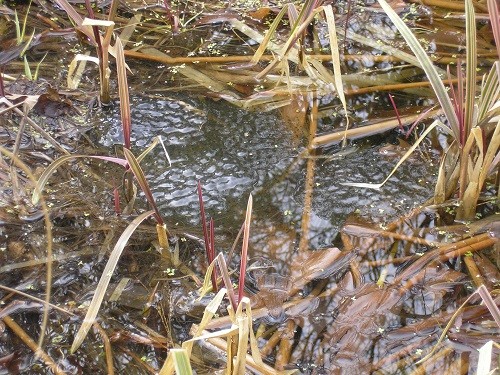
All the new shoots bursting out all over the garden are the subject of this month’s Garden Bloggers Foliage Day hosted by Christina at My Hesperides Garden. Everywhere I look, there are wonderful new leaves to grab my attention, so many different colours, shapes, sizes and textures.
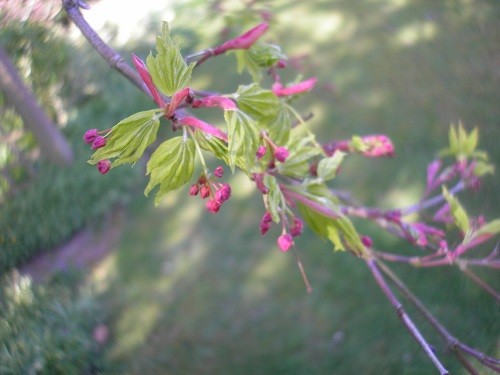
Starting with the tall Acer in the back garden, the new leaves are a lovely pleated, bright green which contrast with the little pink flower buds that are showing already. This tree was here before we were, so I don’t know its full name, bu it turns a wonderful orangey/red in the autumn.
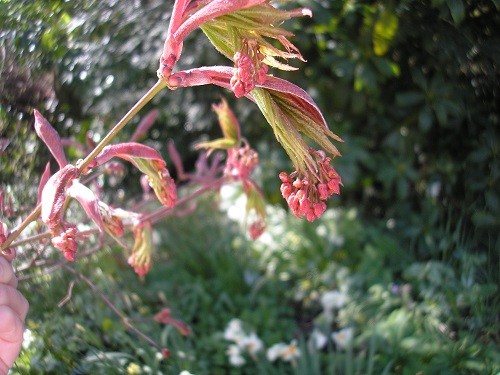
Acer Osakazuki is a little behind and is only just opening its buds where we can see the pink flower buds, the new leaves are all green. This tree turns the most vivid red in the autumn.

Ferns are unfolding, this is Matteuccia struthiopteris, one of a few that I have planted in the ditch.

All the Heucheras are waking up and making new leaves, time to tidy away the old leaves!

The Japanese painted fer, Athyrium niponicum Pictum, contrasts with everything around it, it has such beautiful fronds.
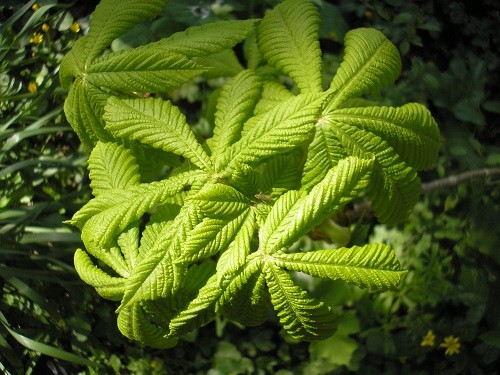
Lovely new leaves of one of our horse chestnuts. The leaves are so thin and vulnerable at this stage, it is such a shame that by July they will have been infested with the moth larva that eats them from within and then they will be green with horrible brown blotches. The experts say it doesn’t damage the tree but each year the trees can’t photosynthesise properly, so I think they might become weaker and weaker, I really hope this isn’t the case. It has been noticed that blue tits are pecking the grubs out from the leaves, hopefully they will teach each other about this wonderful source of protein – a case of nature helping itself.

Pieris Forest Flame with lovely red new leaves, who needs flowers when the new growth is as attractive as this?

A cousin of the kiwi fruit, Actinidia kolomicta had beautifully coloured leaves. As they age they become more pink, they look lovely when both white and pink are on the leaves.

New growth on roses starts the rose season off early, all the new growth is beautiful, but they will soon turn green.

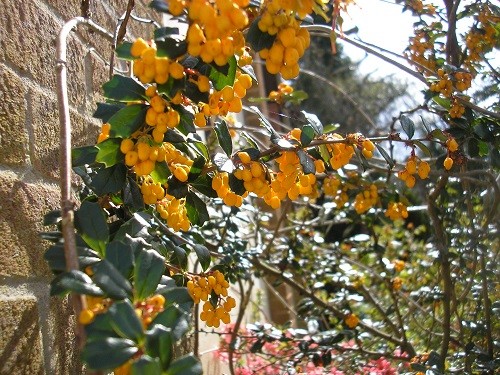
All the berberis bushes in the garden are sporting their new leaves, which look so beautiful with the sun shining through them.

Where has this Mahonia seedling come from? We have a bush in the front garden, this seedling is about 30ft away in the back garden. It will have to be potted up as there isn’t room for it to develop where it now is.
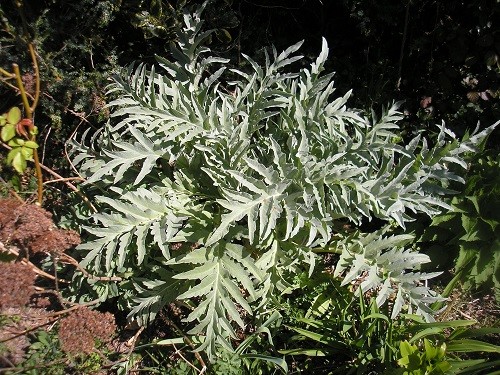
The cardoon in the side border by the field (Cynara cardunculus) is growing nicely, getting better and better each year, it is recovering from being swamped by the hedge behind it.

Just starting to show new green growth is Pittosporum Tom Thumb. Soon the new growth will be a lot more noticeable before it finally turns dark maroon/brown and blends in with the older leaves.

The bog garden is waking up, all the candelabra primulas are starting to grow, it won’t be long before the rainbow of flowers start appearing. In the meantime I can enjoy the leaves getting bigger and bigger each day.

Also in the bog are clumps of our wild iris, Iris pseudacorus variegata. The leaves look lovely before they flower, when they revert to plain green.
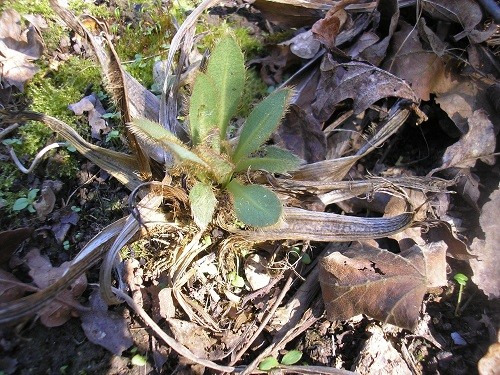
This is the only Meconopsis Lingholm that has survived the winter, I don’t know why it is the only one, so I hope this one flowers and provides me with some seed for next year. Only 2 flowers had viable seed last year, all the other flower heads were filled with a very fine dust which is no use at all.
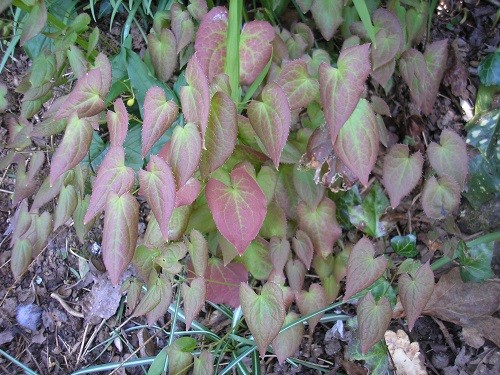
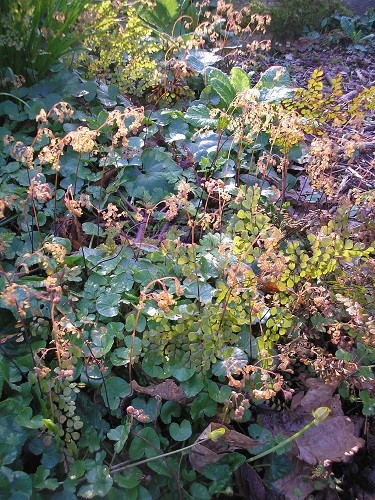
Epimedium have beautiful leaves, starting out with a purple flush to them.
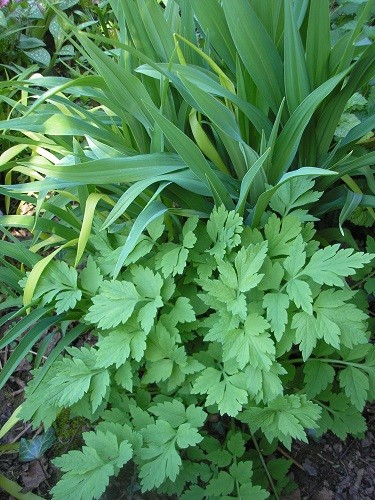
There are lots of clumps of Hemerocallis foliage, this one is accompanied by the welshpoppy, Meconopsis cambrica.
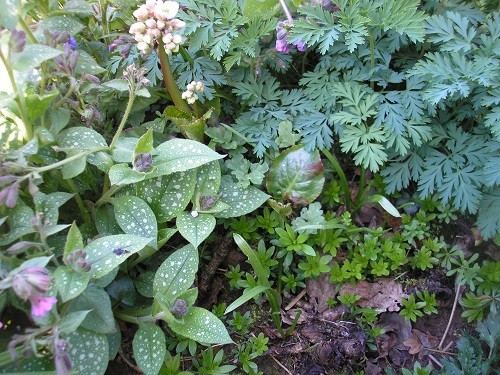
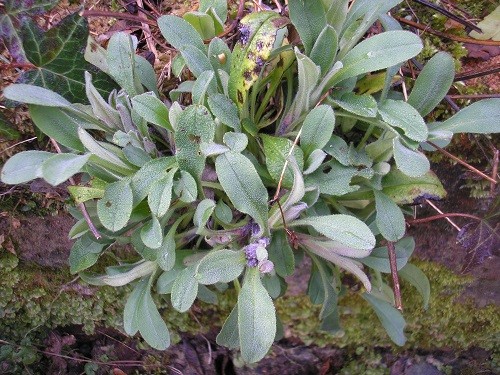
Pulmonaria, Dicentra and Gallium odoratum mixing together. I will have to watch the Gallium as it spreads a lot. Somehow it has come to this bed from the woodland where it forms groundcover.

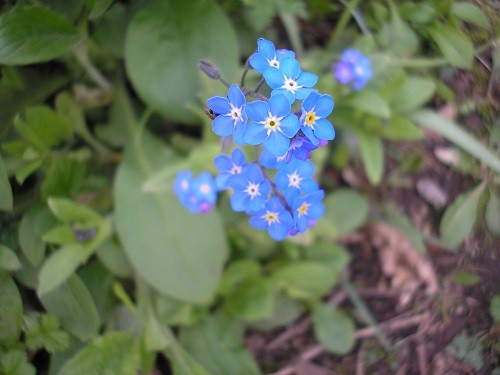
Brunnera Jack Frost is happy mixing with Hemerocallis on the left and Aquilegia on the right. The blue flower is a forget me not and not the Brunnera which has very similar flowers.

In the back garden are two contrasting shrubs, a blue conifer on the left and the yellow leaves of Philadelphus coronarius aurius.

Rearing up like lots of baby cobras are the fronds of Asplenium scolopendrium, the hart’s tongue fern, I love the shapes they make!

I will leave you with early morning sun on the Amelanchier. The new leaves emerge bronze before turning green and then back to orange/red before falling in the autumn, my favourite small tree.
Thank you to Christina at My Hesperides Garden for hosting this monthly meme which encourages us to look more closely at the foliage in the garden, do pay her a visit and see lots of interesting foliage.